.png)

Critical Minerals Are the New Oil. America Is Losing the Race. Here Is How We Fight Back.
- Marco Lopez

- May 10
- 4 min read
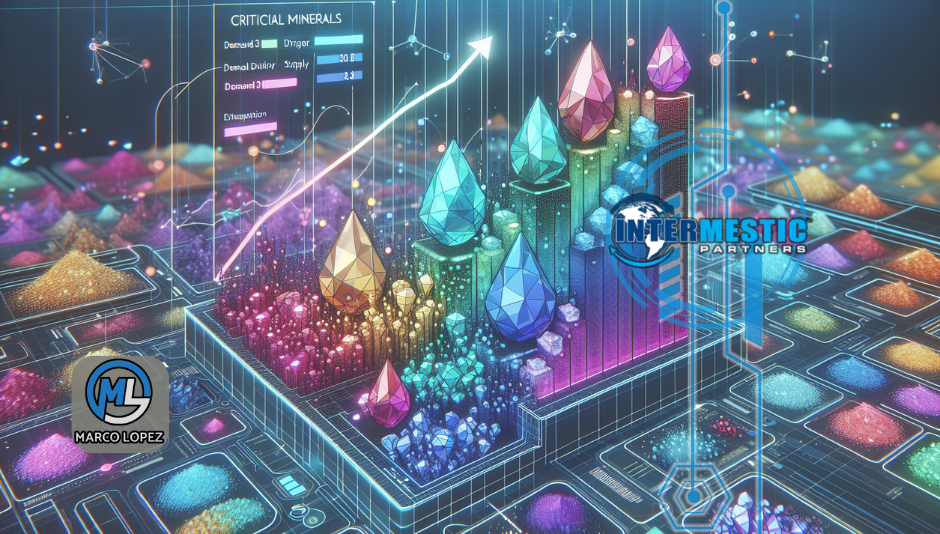
Every superpower in history has been defined by the resource it controlled. For a century, that resource was oil. Today, it is lithium, cobalt, copper, and rare earth elements. And right now, China controls the board.
I have spent my career at the intersection of borders, trade, and national security, as a former border city mayor, Director of the Arizona Department of Commerce, and Chief of Staff at U.S. Customs and Border Protection overseeing a $13 billion budget and 60,000 personnel. What I am watching unfold in the critical minerals race keeps me up at night. But it also tells me exactly where the opportunity is.
The New Black Gold
Critical minerals are not a niche commodity story. They are the backbone of every technology that defines the 21st century: electric vehicles, semiconductors, solar panels, defense systems, and AI hardware. A single EV battery requires up to 25 kilograms of lithium. The lithium-ion battery market alone is projected to surpass $100 billion.
This is not a future threat. It is a present reality.
China currently controls approximately 80 to 90 percent of the global rare earth elements supply chain. During the U.S. - China trade war, Beijing openly threatened to cut off American access to these materials. That moment should have been a five-alarm fire for Washington. In many ways, it was. But the response has been far too slow.
The Democratic Republic of Congo produces roughly 70 percent of the world's cobalt, a mineral essential to nearly every rechargeable battery on the planet. Yet most of that cobalt is processed and refined in China before it ever reaches a Western manufacturer. America does not have a supply problem. It has a processing and proximity problem.
The Hemisphere Answer Nobody Is Talking About
Here is the strategic insight that too few in Washington have fully acted on: the solution to China's critical minerals dominance does not require going to the other side of the world. It is directly south of the U.S. border.
Mexico and the broader Western Hemisphere hold enormous deposits of copper, lithium, and other critical materials. The U.S. already has a framework for secure trade with Mexico through USMCA. What is missing is the infrastructure, the capital, and the cross-border strategy to activate it.
This is precisely why Intermestic Capital, the investment and development arm of Intermestic Partners, is advancing real projects in this space right now.
What We Are Building
Through Intermestic Capital, we am actively developing two projects designed to strengthen American supply chain security and compete directly against China's stranglehold on critical material processing:
The Cobalt Processing Project in Yuma, Arizona positions the U.S. to take back a key step in the battery supply chain. By processing cobalt domestically and in proximity to the border, we reduce dependency on Chinese refineries and create high-value manufacturing jobs in the American Southwest.
The SouthBridge Nogales Industrial Project, a 200-hectare development spanning the U.S.Mexico border corridor, is designed to be a nearshoring hub for exactly the kind of advanced manufacturing that TSMC and Intel are already betting on in Phoenix. Semiconductors, critical mineral processing, and advanced logistics infrastructure belong in this corridor.
This is not hypothetical. These are active projects. And they sit at the convergence of national security, economic competitiveness, and the cross-border integration that Intermestic Partners has been building since 2011.
The National Security Dimension
The conversation around critical minerals is increasingly a defense conversation. Rare earth elements are embedded in fighter jets, missile guidance systems, night vision equipment, and naval vessels. When China controls the supply chain, it holds leverage not just over our economy, but over our military readiness.
At Intermestic Partners, we think about this through the lens of territorial intelligence and hemispheric security. The same border corridors that move trade also move risk. That is why our work with Ecosystem 360, a territorial intelligence platform in active demonstration with U.S. Customs and Border Protection, is part of the same strategic picture as our capital investments.
Securing the supply chain and securing the border are not separate missions. They are the same mission.
What Needs to Happen Now
The U.S. cannot afford to treat critical minerals as a long-range policy priority. Three things need to happen in parallel:
Activate the hemisphere. USMCA is an underutilized instrument for building a North American critical minerals alliance. Mexico should be a partner, not an afterthought.
Invest in processing, not just extraction. Owning the mine means little if China owns the refinery. Domestic and nearshore processing capacity is the real competitive advantage.
Connect capital to national security strategy. Private investment in projects like the ones Intermestic Capital is developing must be recognized as strategic infrastructure, not just commercial real estate.
The approximately 40 million Mexican-connected residents living in the United States represent a human bridge between two economies that, together, can build a supply chain China cannot touch. That community, that connection, and that geography are assets hiding in plain sight.
The Window Is Open. Not Forever.
I have spent fifteen years building Intermestic Partners on the conviction that the U.S.Mexico border is not a liability. It is America's greatest competitive asset.
The critical minerals race is not lost. But it will be if we wait.
If you are a policymaker, investor, or business leader who wants to understand how to position for what comes next, I want that conversation. And if you want to follow this work in real time, subscribe to my weekly newsletter where I track the trade winds, border security developments, and economic moves that most people miss until it is too late.
The border is not a problem to manage. It is a platform to build on. Let's build.
👉 Subscribe to my newsletter at marcolopez.com | Connect with Intermestic Partners


loved this write-up. instagram video downloader is useful for storing important content.