.png)

Leading Through the Storm: What Today's Global Chaos Demands of Every Leader 🌊

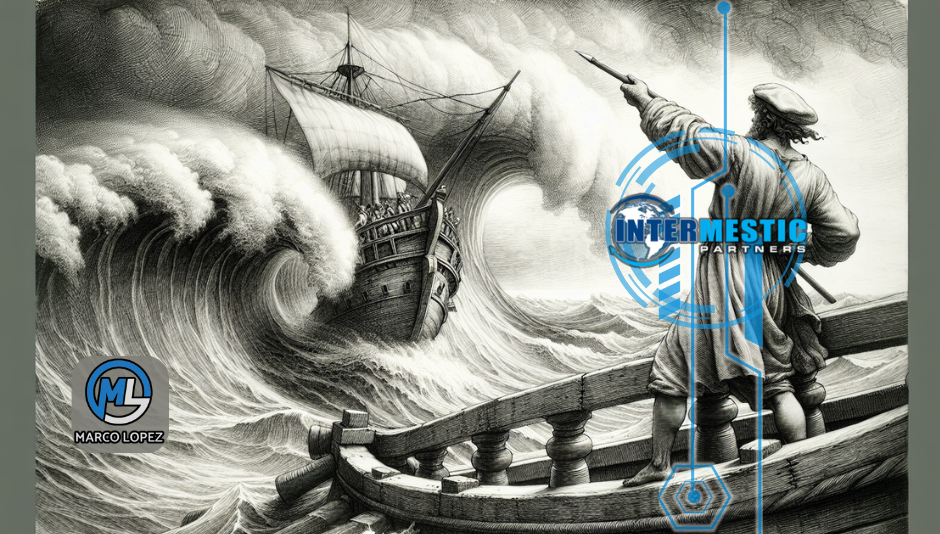
The Storm Is Not Coming. It Is Already Here.
Trade wars are reshaping global supply chains overnight. Tariffs are disrupting industries that took decades to build. Conflicts in Ukraine, the Middle East, and beyond are sending shockwaves through energy markets, refugee flows, and diplomatic relationships. Gas prices are climbing. Inflation is persistent. And the border, my border, remains one of the most complex and politically charged pressure points in American public life.
This is not a hypothetical leadership challenge. This is the environment every serious leader is navigating right now, in real time, with real consequences.
As a former Chief of Staff at U.S. Customs and Border Protection, former mayor of a border city in Arizona, and CEO of Intermestic Partners, I have led through crises that most leadership textbooks do not cover. What I have learned is that uncertainty does not respect titles, sectors, or borders. But the principles that cut through it are remarkably consistent.
The World We Are Actually Leading In
Let us be clear about the landscape. It is not stable and it is not simplifying.
Trade and tariffs are no longer background policy noise. The reimposition and escalation of tariffs between the U.S. and its trading partners, including Mexico and China, are forcing companies to rethink supply chains, pricing models, and cross border partnerships at extraordinary speed. Organizations that built their strategies on predictable trade relationships are being forced to rebuild in real time.
Energy prices are a direct consequence of geopolitical instability. The war in Iran disrupted global energy markets in ways still reverberating through household budgets and industrial operating costs. High gas prices are not just inconvenient. They are a compounding pressure on every sector of the economy simultaneously.
Border complexity has reached a level that defies simple political framing. The human reality at the border involves migrants fleeing violence and economic collapse, cross border trade worth billions of dollars annually, and national security imperatives that must coexist with humanitarian obligations. I have managed all of these dimensions at once. None of them yield to easy answers.
Geopolitical realignment is accelerating. Alliances that seemed settled are being renegotiated. The rules based international order is under strain. And the decisions made in boardrooms, government offices, and community organizations over the next several years will shape the trajectory of North America for a generation.
During the peak of the COVID-19 pandemic, U.S. Customs and Border Protection processed over 11 million cargo shipments in a single month while simultaneously managing a humanitarian crisis, enforcing public health restrictions, and operating with a workforce facing its own personal risks. The border did not pause. Neither did the leadership demands placed on the people managing it.
What the Border Taught Me About Leading Through Chaos
Five principles have proven consistently effective across every crisis I have navigated, from the border to the boardroom:
Risk management is a daily discipline, not a crisis response. At the border, waiting for a situation to become a crisis before assessing risk is not an option. The same applies to business leaders facing tariff exposure, supply chain vulnerability, or geopolitical risk. The leaders who survive disruption are the ones who mapped their exposure before the disruption arrived.
Vision is the anchor, not the destination. When circumstances change by the hour, the specific plan becomes less important than the clarity of purpose behind it. Leaders who can articulate why their organization exists and where it is ultimately heading give their teams something to orient around even when the path forward shifts constantly.
Communication must outpace confusion. In a crisis, the information vacuum fills itself, almost always with fear and rumor. Leaders who communicate transparently, frequently, and with honesty about what they do not yet know build the kind of trust that holds teams together under pressure. Silence is never neutral. It is always interpreted as concealment.
Empathy is a strategic asset. This is not sentiment. At the border, the leaders who treated every individual, whether a migrant family, a customs officer, or a trade partner, with genuine dignity consistently achieved better outcomes than those who defaulted to enforcement posture alone. In business, leaders who acknowledge the human weight of difficult decisions earn the loyalty that carries organizations through the hardest moments.
Adaptability is the only sustainable competitive advantage. Every plan I have ever made at the border required modification within 48 hours of implementation. The same is true in business, in policy, and in cross border strategy. The ability to adjust without losing direction is the defining skill of effective leadership in genuinely uncertain times.
What This Means Across Sectors Right Now
The border is not the only place where these principles are being tested. They are being tested everywhere, simultaneously.
In business, leaders are managing tariff exposure, renegotiating supplier relationships, and making workforce decisions under conditions of profound economic uncertainty. The ones navigating this well are those who assessed risk early, communicate with radical transparency, and build adaptive strategies rather than rigid plans.
In government, the leaders earning public trust are those acknowledging hard realities, making decisions with the information available, and demonstrating genuine accountability when outcomes fall short of intentions.
In healthcare and education, the sustained aftermath of the pandemic continues to test leaders who must balance institutional constraints with the evolving needs of the people they serve.
The Cross Border Dimension of Today's Leadership Challenge
No leadership challenge in North America today exists purely within a single country's borders. Tariffs, migration, energy, critical minerals, semiconductor supply chains, and binational economic development are all cross border by nature.
Navigating this terrain requires more than good instincts. It requires experience, relationships, and a framework built on genuine understanding of how both sides of the border operate. That is the foundation of Intermestic Partners, founded in 2011 to help top national and international companies navigate exactly this complexity.
Cross border leadership is not a specialty for a narrow set of industries. In today's environment, it is a core competency for any organization with ambitions that extend beyond its own zip code.
The Constant in an Inconstant World
The geopolitical map will keep shifting. Tariff policies will change with administrations. Energy prices will fluctuate with conflicts and weather patterns. The border will remain complex regardless of which party holds power in Washington.
What does not change are the leadership principles that allow organizations and individuals to navigate complexity with clarity, integrity, and purpose. Risk awareness. Clear vision. Transparent communication. Genuine empathy. Relentless adaptability.
The storm is real. The compass still works.
Ready to build a leadership and cross border strategy designed for the world as it actually is today? Connect with Intermestic Partners and let's navigate the complexity together.


Comments